Chopping the Sacred: How Reservation Beatmakers Are Turning Tradition Into the Future of Hip-Hop
There's a producer working out of a two-bedroom house on the Navajo Nation right now who has beats placed with rappers in Phoenix, Minneapolis, and Seattle. He's never signed a contract with a label. He's never been featured in a trade publication. His name, for the moment, stays private — not because he's shy, but because the work he's doing exists in a space that the mainstream music industry doesn't have language for yet.
That's kind of the point.
Across Indian Country — from the Pine Ridge Reservation in South Dakota to the Tulalip territory in Washington State — a loose, largely unacknowledged community of Indigenous beatmakers is doing something genuinely new. They're pulling from the deep well of their own cultural traditions: hand drum recordings passed down through families, archival field recordings captured by anthropologists decades ago, ceremonial song fragments that exist in the memory of elders and, increasingly, in digital audio workstations. They're chopping, pitching, layering, and looping these sounds into instrumentals that feel simultaneously ancient and completely of the moment.
And they're doing it entirely on their own terms.
The Ethics Nobody Else Is Asking About
Here's where it gets complicated — and interesting. The mainstream conversation around sampling has always centered on intellectual property law: who owns what, who owes who, how many seconds of a recording you can use before you need a clearance. That framework assumes music is private property, a commodity with a traceable owner.
But what happens when the source material is communal? When a drum pattern belongs not to an individual but to a nation? When a song was never written down, never registered with the Copyright Office, because it predates the very concept of copyright by centuries?
Indigenous producers are navigating these questions in real time, and the answers they're arriving at don't map cleanly onto anything the Recording Industry Association of America has a policy for.
Take Nataanii Means — rapper, activist, and someone who has worked closely with Indigenous producers on projects that deliberately blur the line between hip-hop and ceremony. His position, shared by many in this scene, is that sampling within your own tradition isn't extraction. It's continuation. "When I use something from my culture in my music, I'm not taking from it," he's said in interviews. "I'm keeping it alive. I'm making sure it doesn't just sit in a museum somewhere."
That philosophy is widespread among the producers in this underground scene, but it doesn't mean anything goes. There are real, ongoing conversations within communities about what's appropriate to use publicly and what needs to stay protected. Ceremonial songs that are meant only for specific contexts — healing rituals, funerary rites, seasonal ceremonies — are generally understood to be off-limits, even by producers who technically have access to them. The line isn't drawn by lawyers. It's drawn by relationships, by responsibility, by knowing your community well enough to understand what you're holding.
Bedroom Studios, Global Reach
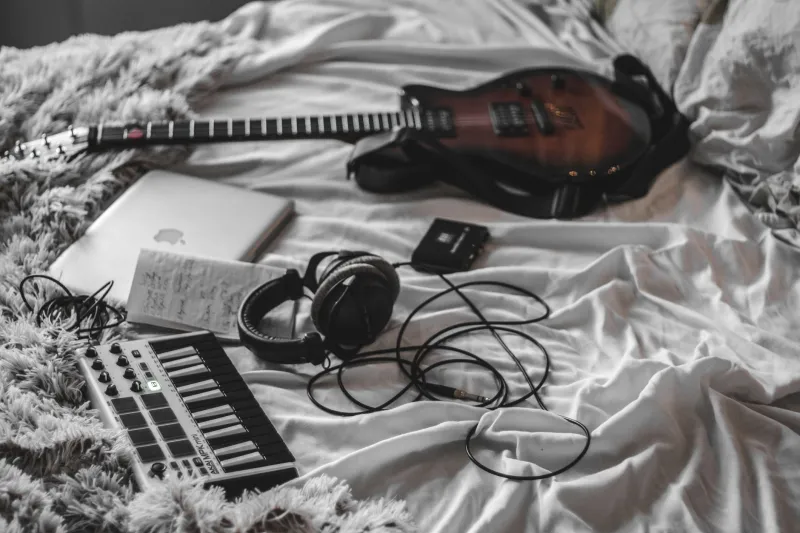
What makes this scene particularly remarkable is the infrastructure — or more accurately, the lack of it. These producers aren't working out of professional studios with acoustic treatment and vintage outboard gear. They're working on laptops, on modest home setups, on whatever they can afford or cobble together. Ableton, FL Studio, and GarageBand are the tools of choice. A decent audio interface, some headphones, and a hard drive full of recordings are often all it takes.
The geographic isolation of reservation communities, long treated as a barrier to participation in the music industry, has become something else entirely in the streaming era. A producer in rural New Mexico can upload a beat tape to BandCamp at midnight and have it in the ears of a rapper in Toronto by morning. The gatekeepers who once controlled access to distribution — labels, radio stations, physical record stores — are simply less relevant than they used to be.
This doesn't mean the playing field is level. It isn't. Broadband access on many reservations remains genuinely inadequate, a infrastructural injustice that has real consequences for artists trying to work digitally. But the producers who have found workarounds — driving to town for better connections, investing in mobile hotspots, collaborating remotely through shared cloud storage — are building something that looks a lot like an independent creative economy.
The Loop as Political Statement
It would be a mistake to treat this as purely an aesthetic movement. The producers making this music are acutely aware of the history they're working against.
For most of the 20th century, Indigenous musical traditions were either ignored by the mainstream industry or exploited without credit, without compensation, and without consent. Non-Native artists built careers sampling and approximating the sounds of Native culture while actual Native musicians struggled to get label meetings. The New Age music industry of the '80s and '90s made millions off vaguely "tribal" sounds that had nothing to do with any real tribal nation. That history is present in every conversation these producers are having about what it means to control their own source material.
When a beatmaker on the Oglala Lakota reservation takes a recording of a traditional song and transforms it into an instrumental that gets placed in a hip-hop project, that's not just a creative act. It's a reclamation. It's a refusal to let the culture be mediated by outsiders. It's proof that Indigenous people don't just exist in the past tense — they're producing the soundtrack of right now.
Who's Listening
The reach of this scene is quietly expanding. Producers who started out making beats for local rappers are increasingly getting inquiries from artists far outside their immediate communities. Some are licensing beats through platforms like Airbit and BeatStars. Others are building direct relationships with artists who find them through SoundCloud or Instagram. A few are starting to get noticed by independent labels — though most are skeptical of label involvement and cautious about what signing anything would mean for their creative autonomy.
The artists placing beats with Indigenous producers aren't all Native themselves, which raises its own set of questions about cultural exchange versus cultural appropriation. The producers we've spoken to tend to approach this case by case, thinking carefully about context, intent, and whether the artist using their work is doing so in a way that honors rather than flattens what they're hearing.
The Sound of What's Coming
If you haven't heard this music yet, that's partially by design. A lot of it circulates through channels that aren't optimized for algorithmic discovery — private SoundCloud pages, Telegram groups, direct download links shared in community spaces. Some producers are deliberately keeping their work underground while they figure out the right way to bring it to a wider audience without losing control of the narrative.
But it's getting harder to stay quiet when the music is this good.
What's being made in these reservation bedroom studios right now is some of the most sonically adventurous, culturally grounded, and politically resonant instrumental music in the country. It doesn't sound like anything that's been packaged and sold to you before, because it was never made for that purpose. It was made to keep something alive — and to prove, once again, that Indigenous creativity doesn't need anyone's permission to thrive.
We're listening. You should be too.