Every Step, Every Song: How Native Musicians Are Becoming the Soundtrack to Life Itself
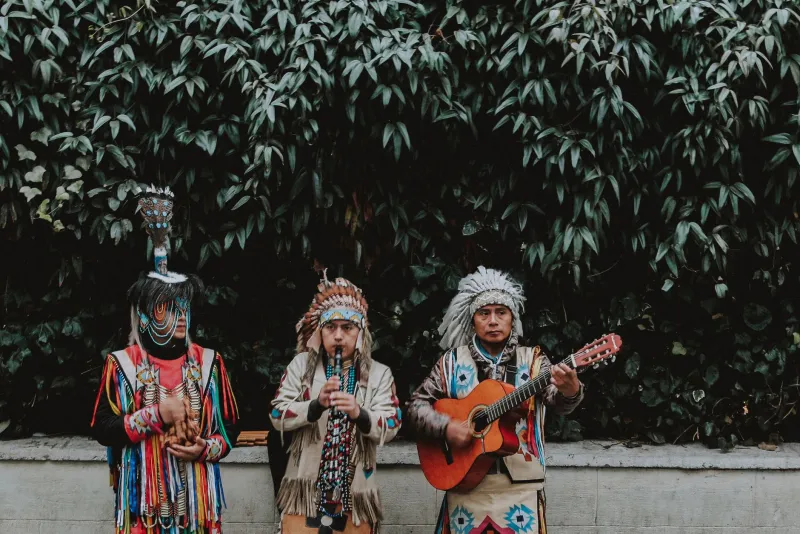
There's a moment at a Diné wedding in New Mexico when the room goes quiet — not the awkward silence of a sound system glitch, but the kind of hush that tells you something real is happening. A musician in the corner begins to play, and the melody carries something older than the room itself. It's composed specifically for this couple, for this day, woven from traditional forms and shaped by a composer who grew up speaking the same cultural language as the people crying happy tears in the front row.
That moment? It wasn't always possible. For a long time, it barely existed at all.
Across Indian Country, a generation of Native musicians is quietly stepping into one of the most intimate roles an artist can hold: scoring the milestones of human life. Births. Coming-of-age ceremonies. Graduations. Weddings. Funerals. The moments that define us, mark our transitions, and anchor us to the people we love. And for Native families who've spent generations navigating cultural rupture, having those moments held by music that actually understands where you come from — that's not a small thing.
That's everything.
The Gap That Nobody Talked About
Decades of forced assimilation — boarding schools, relocation programs, the systematic suppression of Native language and ceremony — didn't just damage communities. They created a specific kind of silence: the absence of culturally grounded music at the moments when people need it most.
When a Native family gathers to celebrate a daughter's kinaalda, or a son's first powwow dance, or the passing of an elder who carried irreplaceable knowledge, what do they play? For too long, the options were either generic Western music that carried none of the cultural weight of the occasion, or a scramble to find traditional songs that had been partially lost, misremembered, or stripped of context.
Musicians like Shoshone-Bannock composer and multi-instrumentalist Tara Runningwater — who has spent the last decade creating commissioned pieces for life events across the Pacific Northwest and Intermountain West — describe the gap in terms that are both practical and deeply personal.
"Families would come to me and say, 'We want something that sounds like us. Not a generic pan-Indian sound, not something from a movie, not a hymn. Something that sounds like us,'" she says. "And I understood exactly what they meant, because I'd felt that absence too."
Runningwater now maintains a steady practice built almost entirely around what she calls "milestone commissions" — original compositions for specific families, specific occasions, specific people. Her process begins with conversation: long, unhurried talks about family history, tribal affiliation, personal stories, the person being honored or celebrated. The music comes last.
Composing for the Ceremony, Not the Concert Hall
There's an important distinction between music written to be performed and music written to be lived in. The composers doing this work understand that difference instinctively.
Ojibwe flutist and composer Marcus Desjarlais, based in Minnesota, has built a reputation for creating pieces that accompany naming ceremonies, graduation celebrations, and memorial gatherings for Anishinaabe families throughout the Great Lakes region. He's quick to note that his work isn't about showcasing technical virtuosity — it's about disappearing into the moment.
"A good piece of ceremonial music shouldn't make people think about the music," he explains. "It should make them think about the person, the moment, the community. If someone walks away saying, 'That was a beautiful composition,' I did okay. If they walk away saying, 'That was a beautiful day,' I did my job."
Desjarlais draws on traditional Anishinaabe musical structures — specific rhythmic patterns, particular intervals and modes — while writing melodies that feel accessible to family members who may have grown up with limited exposure to traditional forms. It's a careful balance, one that requires both deep cultural knowledge and genuine compositional skill.
"You can't fake the foundation," he says. "If you don't know the tradition, the music will feel hollow, even if it sounds pretty. People feel it. They always feel it."
When Reclamation Sounds Like a Graduation Song
For many Native families, commissioning Indigenous music for a milestone event is explicitly understood as an act of cultural reclamation. It's a conscious choice to say: this moment belongs to us, and the music that frames it will belong to us too.
Cherokee songwriter and vocalist Leila Sixkiller, who lives and works in eastern Oklahoma, started writing graduation songs after her niece's high school ceremony felt hollow in a way that was hard to articulate.
"She'd worked so hard. The family was so proud. And we're sitting there listening to 'Pomp and Circumstance' for the hundredth time, and it just... it didn't hold us," Sixkiller recalls. "I went home and wrote her a song. Something in Cherokee, something that talked about where she came from and where she was going. We sang it at the family celebration afterward, and my aunt cried for twenty minutes."
Word spread. Sixkiller now receives requests from Cherokee families throughout Oklahoma and beyond — not just for graduations, but for weddings, baby showers, and increasingly, for memorial pieces honoring elders who've passed. Each song is original. Each one is tied to a specific person and a specific story.
"These songs are heirlooms," she says simply. "They'll be sung at that person's grandchildren's milestones someday. That's the point."
The Business of Sacred Moments
It's worth acknowledging that this work exists at an interesting intersection of artistry, cultural responsibility, and livelihood. Most of the musicians doing it have developed thoughtful frameworks for navigating the tension between the sacred nature of what they create and the practical reality of needing to sustain their practice.
Runningwater charges on a sliding scale based on family income, never turning away a commission because of cost. Desjarlais retains no rights to pieces commissioned for private ceremonies — the music belongs entirely to the family. Sixkiller maintains a clear distinction between songs written for private families and the music she releases publicly, with strict agreements about how commissioned pieces can and can't be shared.
None of them describe this as a tension so much as a set of values they've worked out deliberately.
"The music I make for a family is theirs," Desjarlais says. "Full stop. I'm not going to sample it, release it, use it in my portfolio without permission. That's not how you treat something sacred."
What This Movement Means Going Forward
The quiet growth of Indigenous milestone music — commissioned, culturally specific, deeply personal — is doing something that's hard to quantify but impossible to miss: it's filling the silence that colonization created.
When a Lakota baby is welcomed into the world with a song composed in their honor by a musician who understands the cultural weight of that welcome, something is restored. When a Muscogee couple dances at their wedding to music rooted in their own tradition, something is reclaimed. When an elder is carried out of this world on the sound of a drum played by someone who knew exactly what that drum means — that's not just music.
That's sovereignty. That's continuity. That's a community saying, in the most human way possible, that they are still here.
And they've got the songs to prove it.