When the Song Becomes the Fight: Indigenous Artists Turning Music Into a Land Rights Weapon
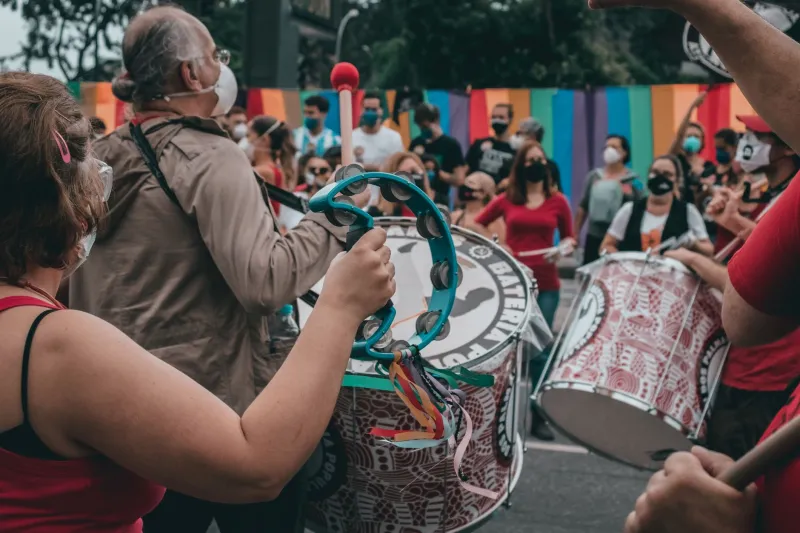
There's a moment that keeps repeating itself across Indian Country, in slightly different forms, in slightly different landscapes. A drum starts. A voice rises. And somewhere nearby, a pipeline company or a federal agency or a state legislature feels something shift. Not immediately. Not dramatically. But something moves.
That's not metaphor. That's strategy.
Indigenous artists across the United States have spent the last decade building something that looks, from the outside, like a music scene — but functions, from the inside, like a sovereignty infrastructure. Recordings, live performances, benefit concerts, and viral audio moments are being deployed as deliberate instruments in active land rights campaigns. And the wins are starting to accumulate in ways that are genuinely hard to ignore.
Standing Rock Changed the Blueprint
If there's a turning point in the modern relationship between Indigenous music and land rights organizing, it runs directly through the Standing Rock Sioux Reservation in North Dakota. The 2016 Dakota Access Pipeline protests drew global attention, and music was never incidental to that. It was load-bearing.
Artists like Nahko Bear, A Tribe Called Red, and members of the Lakota community performed at the camps, and those performances weren't just morale boosters — they were media moments that reframed the entire narrative. When footage of traditional drum circles circled the globe alongside footage of water cannons, the contrast told a story that no press release could have manufactured. The emotional weight of Indigenous song cut through in a way that legal briefs simply couldn't.
But beyond the optics, Standing Rock catalyzed something more structural. Artists began understanding that their platforms were fundraising infrastructure. Benefit tracks, merchandise tied to legal defense funds, streaming revenue directed toward tribal legal teams — these became standard tools in the organizing toolkit. The song wasn't just protest. It was a revenue stream for the fight.
Lyla June and the Architecture of Persuasion
Few artists have been as deliberate about this fusion as Lyla June Johnston, the Diné and Tsétsêhéstâhese musician and scholar who has built her entire creative practice around the idea that Indigenous art is inseparable from Indigenous governance.
Her performances at land rights rallies — from Bears Ears in Utah to Oak Flat in Arizona — are carefully constructed to move audiences who might arrive skeptical and leave converted. She's spoken openly about the choice to use music as a persuasion tool, not just an expression of grief. "Grief is useful," she's said in various contexts, "but it has to lead somewhere."
At Oak Flat, where the San Carlos Apache Tribe has been fighting to prevent a copper mine from destroying a site central to Apache religious practice, Lyla June's presence at rallies helped draw national media coverage that translated into congressional attention. The Apache Stronghold legal battle — which has wound its way through federal courts arguing for First Amendment religious freedom protections — has benefited from sustained public pressure that artists like Lyla June helped generate and maintain.
That's not a soft contribution. That's political infrastructure.
Benefit Tracks as Legal Tender
The mechanics of how music converts to legal power are worth understanding, because they've gotten surprisingly sophisticated.
The model that's emerged in several tribal communities works something like this: an artist records a track or an EP explicitly tied to an active land rights campaign. The release is accompanied by transparent documentation of where the revenue goes — usually split between a tribal legal defense fund and a community organization on the ground. Streaming platforms are used, but direct sales through Bandcamp or tribal-run digital storefronts are prioritized, because the revenue share is significantly better.
The Lummi Nation in Washington State has used this model in connection with their decades-long effort to protect Whatcom Creek and oppose the Gateway Pacific Terminal coal export project. Local and allied artists have organized benefit releases that have funneled real dollars into legal and advocacy work, while simultaneously keeping the issue visible to audiences far outside the Pacific Northwest.
What makes this effective isn't just the money — it's the sustained attention. A lawsuit can drag on for years. Public interest doesn't naturally sustain itself over that timeline. Music does. A song gets replayed. A playlist stays active. The emotional connection stays warm in a way that a news cycle simply doesn't.
The Sonic Reframing of Sacred Land
There's another dimension to this that's less about fundraising and more about epistemology — about how people understand what land actually is.
One of the core challenges in Indigenous land rights litigation is that American law tends to treat land as property, as a commodity with a dollar value that can be assessed and compensated. Indigenous legal claims often rest on a fundamentally different understanding — land as relative, as living, as irreplaceable in ways that money cannot address.
Music is one of the few tools that can actually transmit that understanding across cultural lines.
When artists like Raye Zaragoza — a singer-songwriter of Akimel O'odham and Hopi descent — write songs about specific rivers and specific mountains with the intimacy of someone describing a family member, something happens in the listener. The abstraction of "sacred site" becomes concrete. The legal argument for irreplaceable harm becomes emotionally legible in a way it wasn't before.
Zaragoza's song "In the River" — written in response to the Standing Rock situation — is a clean example of this. It doesn't argue. It doesn't explain. It makes you feel the water. And that feeling, multiplied across hundreds of thousands of listeners, has a political temperature.
The Long Game
None of this is fast. Indigenous land rights campaigns routinely span decades, and the artists who tie themselves to those campaigns are signing up for a long relationship — not a single protest anthem.
What's different now, compared to even ten years ago, is the infrastructure that's grown up around sustained musical advocacy. Tribal communications teams understand how to amplify artist content. Indigenous-run media platforms — including radio stations, podcasts, and social channels — provide distribution networks that don't depend on mainstream gatekeepers. And a generation of Native artists has grown up watching the Standing Rock moment and deciding, consciously, to build their creative careers in the direction of political utility.
That's a movement, even if it doesn't always call itself one.
At Native Cat Recordings, we've been watching this unfold with something that feels like awe. The idea that a song can show up in a courtroom's cultural context — that a recording can shift a senator's constituent mail — that a drum circle can be the thing that keeps a sacred mountain from being blown apart for copper ore — that's not wishful thinking anymore. It's documented history.
The soundtrack of sovereignty isn't background music. It's the argument itself, delivered in a frequency that legal briefs can't reach and bulldozers can't drown out.
And it's getting louder.