They Couldn't Silence the Song Forever: Native Artists Are Reclaiming What the Boarding Schools Stole
They Couldn't Silence the Song Forever: Native Artists Are Reclaiming What the Boarding Schools Stole
There's a particular kind of silence that gets passed down through families. Not the comfortable quiet of a Sunday morning, but the kind that sits in the chest — heavy, unexplained, inherited. For many Indigenous families across the United States, that silence has a name: the federal Indian boarding school system. And right now, a generation of Native artists is doing something remarkable with it. They're turning it into music.
Between the 1870s and the mid-20th century, the U.S. government forcibly removed an estimated 50,000 to 100,000 Native children from their families and placed them in institutions designed, in the words of one notorious superintendent, to "kill the Indian and save the man." Songs were banned. Languages were beaten out of children. Ceremonies were punishable offenses. The cultural damage was deliberate, calculated, and generational. What those schools couldn't fully account for, though, was the stubborn, irreducible nature of memory — and the artists who would eventually come looking for it.
Digging Through the Silence
For Diné singer-songwriter Sihasin, the reckoning started with her grandmother's stories — or more precisely, the gaps in them. "There were things she wouldn't talk about," Sihasin has said in interviews. "And when you grow up around that kind of silence, you start to understand that something was taken."
That understanding drives a growing number of Native musicians to go looking for what was lost — in tribal archives, in Library of Congress recordings made by ethnomusicologists decades ago, in the memories of elders who held onto fragments of songs the way you hold onto something precious and breakable. It's painstaking, emotionally exhausting work. It's also some of the most vital music being made in America right now.
Artists like the Pawnee-Otoe-Missouria musician Erin Gingrich have been threading archival recordings of their ancestors' songs directly into original compositions, creating something that feels less like folk revival and more like a conversation across time. The old recordings — often scratchy, incomplete, captured by outsiders who didn't always understand what they were documenting — become raw material for something new. The result isn't museum-piece preservation. It's living music, built to breathe.
The Studio as Sacred Space
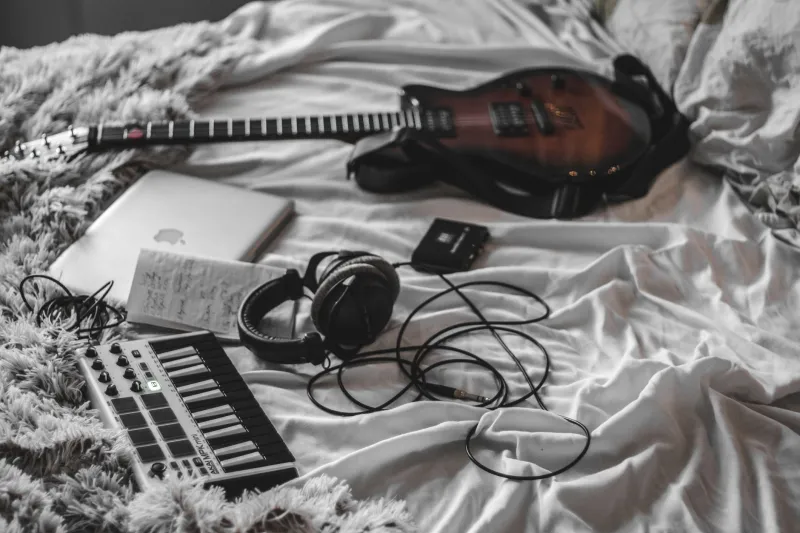
What's striking about this movement is where it's happening. Yes, some of it unfolds in professional recording studios. But just as much of it is taking shape in living rooms on reservations, in community centers, in the back seats of cars on long drives between ceremonies. The tools are democratic now — a laptop, a decent microphone, GarageBand or Ableton — and that accessibility has opened the door for artists who might never have had a pathway into traditional music production.
Lakota hip-hop artist Tall Paul has talked openly about using his music as a way to process intergenerational trauma, weaving spoken-word passages about the boarding school experience into beats that hit hard enough to reach young listeners who might tune out a history lesson. His approach isn't gentle. It isn't meant to be. "We were told to forget," he's said. "I'm not interested in forgetting."
That refusal to forget — and to let audiences forget — is a throughline connecting artists across tribal nations, genres, and generations. From the jazz-inflected compositions of Ojibwe musician Remy Auger to the drone-folk experiments of artists working in the Pacific Northwest, the boarding school era is being confronted directly, unflinchingly, and with a creative energy that feels genuinely urgent.
Elder Knowledge, New Frequencies
One of the most powerful elements of this reclamation work is the role of elders. For artists trying to reconstruct musical traditions that were disrupted or severed, the knowledge held by older community members isn't supplementary — it's foundational. Many artists describe sitting with elders for hours, recording conversations, learning the context behind songs that had been stripped of their meaning by the boarding school experience.
This intergenerational exchange is doing something beyond musical preservation. It's repairing relationships. It's creating space for conversations about trauma that families have sometimes avoided for decades. When a young artist sits down with a grandmother to learn a song that was once forbidden, both of them are participating in something that therapy alone can't fully address. The music becomes the medium for a kind of healing that's communal and deeply personal at the same time.
Choctaw artist Samantha Crain has spoken about how writing songs that grapple with her family's history of forced assimilation changed the way she understood her own identity. "You start to realize that the silence wasn't emptiness," she's explained. "It was a wound. And music is one of the ways you close it."
Not Nostalgia — Resistance
It's worth being clear about what this movement is and isn't. It isn't nostalgia. It isn't a longing to freeze Indigenous culture in some imagined pre-contact past. The artists doing this work are fully contemporary people — they're on Instagram, they're releasing music on Spotify, they're playing festivals alongside indie rock bands and electronic producers. What they're doing is asserting the right to a full cultural inheritance, including the parts that were deliberately destroyed.
That's a political act as much as an artistic one. The federal government's formal acknowledgment in 2022 — through the Interior Department's investigative report — that the boarding school system caused "intergenerational trauma" gave many Native artists a sense of official validation for what they'd already known in their bones. But the music didn't wait for government recognition to begin. It was already happening, in studios and living rooms and community gatherings, because the need for it was too urgent to postpone.
There's something quietly defiant about an artist recording a song in a language that the U.S. government once tried to erase from the earth. Something that says: you didn't finish the job. You never could have.
The Song Continues
At Native Cat Recordings, we talk a lot about amplifying Indigenous voices. But what this particular movement of artists is doing goes even deeper than amplification. They're recovering voices that were actively suppressed — by policy, by violence, by the slow erosion of silence passed from one generation to the next. And they're doing it with craft, with intention, and with a kind of stubborn creative joy that makes it impossible to look away.
The boarding schools are closed. The silence they created is not. But every song these artists record is a small, irreversible act of reclamation. The archive grows. The wound closes, a little. And the music — complicated, grief-stricken, furious, and beautiful — keeps moving forward.
Because it turns out you can silence a generation. You just can't silence the song.