The Roots Ran Deeper Than You Know: How Indigenous Music Built the Backbone of American Sound
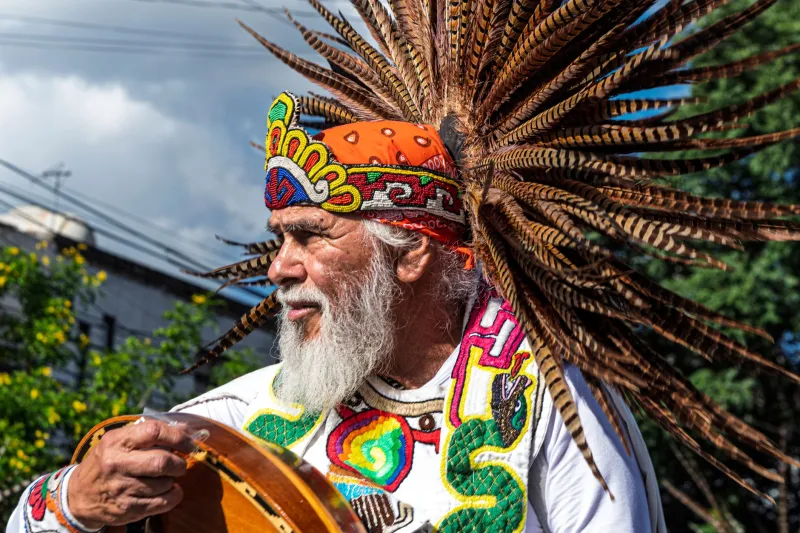
Ask most Americans where country music comes from and they'll say Appalachia. Ask them about the blues and they'll say the Mississippi Delta. Ask them about folk and they'll probably mention Woody Guthrie, maybe Pete Seeger. What almost nobody says — what almost nobody has been taught to say — is that Native American musical traditions were in the room first. They were in the soil before any of those genres had names.
This isn't a fringe theory. It's a documented, if persistently underacknowledged, part of American musical history that scholars and Indigenous artists have been piecing together for decades. The story keeps getting buried, not because the evidence is thin, but because the mainstream music industry has never had much incentive to dig it up.
Call-and-Response Didn't Start Where You Think
One of the most recognizable features of American roots music — from gospel to early country to the blues — is the call-and-response structure. A vocalist throws out a phrase, the melody (or a chorus, or an instrument) answers it back. It feels elemental, almost conversational. Music historians have largely credited this pattern to West African musical traditions carried over through the slave trade, and that lineage is absolutely real and vital.
What gets left out of that story is that call-and-response vocal patterns were already deeply embedded in Native American ceremonial and social music across the continent long before European contact. Tribes from the Great Plains to the Pacific Northwest used layered vocal exchanges in ways that bear a striking structural resemblance to what would later emerge in early American popular music. When those traditions collided — through forced proximity, shared labor, intertribal contact, and the slow cultural mixing that happened in places like the Southeast and the Mississippi corridor — the results didn't disappear. They absorbed into the sonic DNA of American music and then got rebranded as something else entirely.
Dr. Beverley Diamond, a prominent ethnomusicologist who has spent decades studying Indigenous music in North America, has written about the way Native musical contributions get flattened into either silence or stereotype in mainstream historical accounts. The pattern is consistent: the influence gets absorbed, the source gets erased.
The Country Music Connection Nobody Talks About
Here's something worth sitting with: early country music didn't emerge in a cultural vacuum. The Appalachian region where so much of it developed was also home to significant Cherokee, Shawnee, and other Indigenous populations, many of whom had been in sustained contact — sometimes violent, sometimes collaborative — with European settlers for generations by the time the first country records were being cut.
The pentatonic scale, which is foundational to both country music and to many Native American musical traditions, is one of those intersections that's hard to dismiss as coincidence. Specific rhythmic patterns used in stomp dances and ceremonial songs across the Southeast share more than a passing resemblance to the syncopated backbeats that would define early country and rockabilly decades later.
Robert Mirabal, the Taos Pueblo musician and two-time Grammy winner, has spoken in interviews about the way traditional Pueblo music carries rhythmic and tonal structures that pop up again and again in what America calls its "original" genres. "They took the sound and left out the people who made it," he's said, in various forms, across years of interviews. That framing — sound without source — is exactly the problem.
Blues, Pentatonics, and the Erasure in the Delta
The Mississippi Delta is where the blues mythology is most concentrated, and for good reason — extraordinary music came out of that region, created largely by Black Americans under brutal conditions of oppression. That history is sacred and shouldn't be minimized.
But the Delta was also Choctaw territory. The Chickasaw Nation had deep roots across Mississippi and Tennessee. The cultural exchange that happened in those spaces — between Indigenous people, enslaved Africans, and European settlers — was complex and multidirectional. The blues didn't emerge from any single source. It emerged from collision.
Ethnomusicologist Victoria Lindsay Levine, who has focused extensively on Choctaw and other Southeastern tribal music, has documented specific melodic and rhythmic elements in early blues recordings that trace back to Indigenous musical forms of the region. The five-note scales. The particular way certain vocal slides are executed. The drone-like repetition that gives early Delta blues its hypnotic quality. These aren't accidents. They're fingerprints.
Folk Music and the Long Forgetting
The American folk revival of the 20th century — the one that produced Woody Guthrie, Lead Belly's mainstream rediscovery, and eventually Bob Dylan — positioned itself as a recovery of authentic American roots. Collectors fanned out across the country recording "traditional" music. What they were rarely framing as traditional, though, was anything that sounded explicitly Native.
That selective definition of "folk" did real damage. It drew a circle around certain sounds and called them American heritage while leaving Indigenous musical traditions outside that circle — despite the fact that those traditions had been on this land for thousands of years before anyone else arrived.
Contemporary Diné (Navajo) musician Sihasin — the duo of Jeneda and Clayson Benally — has pushed back against this framing directly in their music and their public statements. Their work deliberately draws on traditional Diné musical forms while sitting comfortably in rock and folk sonic territory, and the point isn't subtle: this music belongs here because it was always here.
What Listening Differently Sounds Like
So what do you actually do with this information? One place to start is by listening to some of the artists who are actively naming and reclaiming these connections.
Put on a playlist that moves from traditional Lakota honor songs to early Robert Johnson to Hank Williams to Link Wray — a Shawnee musician who invented the power chord, by the way, a fact that still doesn't get nearly enough play in guitar history circles. Listen for the throughlines. The bends. The rhythmic pulses. The way space is used. You'll start hearing a conversation that's been happening for centuries, even when one side of it wasn't being credited.
That's what this site is about, ultimately. Not just celebrating Indigenous artists in the present tense — though we do that loudly and without apology — but understanding that the music you grew up loving, the music that feels most essentially American, has Native roots that deserve to be named.
The Reclamation Is Already Happening
The good news is that this history isn't just being uncovered by academics. Indigenous artists themselves are doing the most important work of reclamation, making music that explicitly connects the dots and refuses to let those connections be buried again.
Label by label, song by song, streaming playlist by streaming playlist, the narrative is shifting. It's slow. The mainstream music industry is not exactly rushing to rewrite its origin stories. But the artists are not waiting for permission.
America's music didn't spring up fully formed from European traditions and African American genius alone. It grew from soil that Indigenous people had been cultivating — musically, spiritually, culturally — for thousands of years. Acknowledging that isn't about taking anything away from anyone. It's about finally telling the whole story.
And the whole story sounds a lot better.